

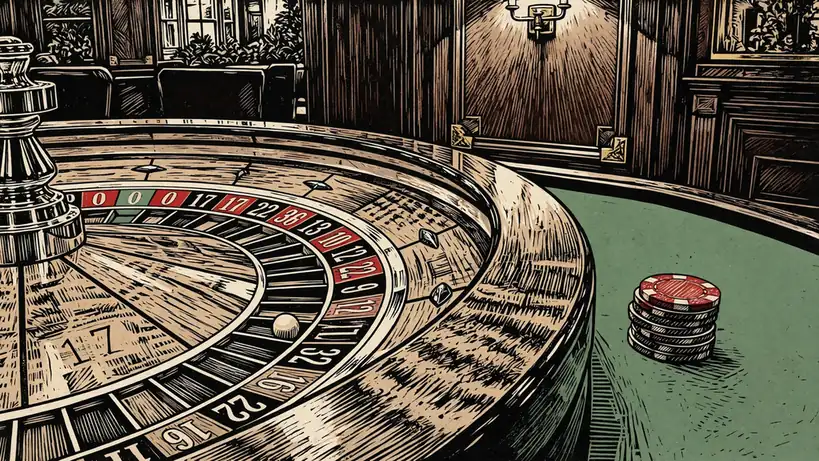
French Roulette’s zero rules, table formats, stakes and controls shape both the maths and the practical choice of an online game.
French Roulette’s Zero Rule—and Why It Changes the Maths
French roulette’s defining difference is not a larger payout but the treatment of zero. Its wheel has 37 pockets: numbers 1 to 36 and one zero. That single green pocket is enough to give the house an advantage on an ordinary even-money bet, such as red or black. La Partage and En Prison change what happens to that bet when zero appears.
On a standard single-zero wheel, an even-money selection wins on 18 numbers and loses on the other 19, because zero is neither red nor black, odd nor even, high nor low. The payout is even money, so the extra losing outcome creates a house edge of 2.70%. The bet may look balanced across the numbered pockets; the zero is the difference in the account.
La Partage reduces that cost for covered bets. If the ball lands on zero, half of an even-money stake is returned rather than the entire stake being lost. The rule applies to even-money wagers, not to every selection on the layout. With La Partage, the house edge on those bets falls to 1.35%. The return of half the stake does not make zero a winning result; it limits the loss attached to that result.
The calculation can be viewed across the wheel’s outcomes. An even-money bet wins on 18 pockets, loses on 18, and loses only half the stake on zero. The reduced loss on that final outcome halves the house edge compared with the standard single-zero treatment. The useful comparison is therefore not simply “one zero versus two”, but how the table settles a bet when the ball reaches zero.
En Prison addresses the same event differently. When zero appears on an eligible even-money bet, the stake is left in play for the next spin rather than being immediately settled as a full loss. If the next result wins the original selection, the stake is returned; if it loses, the stake is lost. The wager is not a fresh prediction with a guaranteed recovery: it remains exposed until the next result settles it.
Hi-Lo Casino UK: What Listings Can Confirm
That distinction matters to the cash flow of a session, even when the long-run advantage is favourable to the player. La Partage returns a fixed portion of the stake immediately. En Prison delays settlement and makes the fate of the stake depend on the following spin. Both rules soften the zero outcome for qualifying bets, but the timing and form of the return differ. The table’s stated rule determines which treatment applies.
French roulette has the lowest house edge among standard variants because of La Partage and En Prison. That description has a defined scope: the rules improve the position on eligible bets compared with ordinary roulette settlement, but they do not remove the house advantage or apply indiscriminately to every bet. A wager on a particular number, for instance, is not an even-money wager and should not be assumed to receive either rule’s protection.
For an online casino French roulette table, the practical question is therefore precise: does the table show La Partage, En Prison, or neither, and which wagers qualify? A French label alone does not explain settlement. The rules attached to the specific game determine whether zero causes a full loss, a half-stake return, or a stake held for another spin. The wheel’s single zero sets the starting point; the zero rule sets the cost of an even-money bet.
The difference is measurable, not cosmetic. With no special zero treatment, the single-zero wheel carries a 2.70% house edge on even-money bets. La Partage brings that figure to 1.35% for those bets, while En Prison is another mechanism for limiting the immediate effect of zero. French rules consequently change the expected cost without changing the wheel’s pockets or making any result more predictable. The zero remains on the wheel; the terms decide how much it costs.
Finding French Roulette Tables Without Mistaking Availability for Value
A casino lobby entry labelled “French Roulette” is a starting point, not proof that the table uses the rules expected from the name. The useful check is whether the game’s own information identifies it as French roulette and states which rules apply. A title, thumbnail or promotional description can establish that a product is being presented as French roulette; the table rules establish what is actually available.
A French label alone does not explain settlement. The rules attached to the specific game determine whether zero causes a full loss, a half-stake return, or a stake held for another spin.
This distinction matters when several roulette games sit beside one another in the same lobby. A French-style table may appear among European roulette, live roulette or other branded versions, while a search facility may return results based on partial matches. The presence of a result therefore confirms little beyond a possible route to the game. Opening its rules or information panel is the next step.
Check the table, not just the lobby
Once a candidate game is open, locate its rules before treating it as a French table. Look for an explicit description of the wheel and the relevant French rules, including La Partage and En Prison where applicable. These terms are more useful identifiers than a decorative French label. If the table information does not say which rules operate, the label alone leaves an important condition unresolved.
The same check applies when a casino offers more than one version under similar names. Live and automated games may have separate entries, and a provider’s branded roulette title may use its own rules. The format does not by itself establish that the table follows French rules. Each game has to be checked on its own terms.
Game information may be available in a rules button, an information icon, a help menu or a separate game description. The position and wording vary, so there is no dependable universal interface to rely on. The relevant test is simple: can the rules for this exact table be opened and read before a stake is placed? If the information is absent or too vague to identify the applicable rules, availability has not been properly confirmed.
Fastest Payouts at UK Online Casinos: What Counts
Treat availability as a fact to verify
UK casinos with French roulette can be identified through their game lobbies, but a listing can change or refer to a game that is not currently accessible. Search the casino’s own lobby for French roulette, then confirm the result by opening it. If the result leads to a product page rather than a playable table, check whether that page describes the game as available to the account in question. Do not infer availability from an old article, a general catalogue or an image.
It is also worth checking whether the casino’s description and the live table agree. A lobby may use a broad title, while the game’s rules provide the exact version. If those details differ, the table rules are the relevant terms for play. If there is no clear way to reconcile them, the game should not be treated as verified French roulette.
A written description is useful for another reason: it can show whether the casino means a particular ruleset or is using “French” as a broad product label. Terms such as La Partage and En Prison should appear in the rules if they are part of the table’s offer. Their mention in a general casino page is not enough; the wording should relate to the specific game being opened.
DO
- Locate the game in the casino’s lobby
- Open the exact table
- Confirm the rules in the information panel
DON’T
- Infer availability from an old article or image
- Assume a French label guarantees La Partage or En Prison
- Rely on a general casino catalogue
Separate the game from the casino’s claims
“French roulette online casino” describes a combination of operator and game, not a quality standard. A casino may provide access to a French roulette product without offering clear table information, while a polished game page may still leave the applicable rules unclear. Availability answers whether a game can be found and opened. It does not establish that its terms are favourable.
For the same reason, labels such as “best” or “premium” do not confirm the roulette variant. Premium branding may describe a table category or presentation, but it is not evidence of French rules. The table’s own rules remain the deciding record for identification. Comparison of the published terms belongs after that identification, not in place of it.
Where the operator provides an RTP figure for a roulette game, it should be accessible with the game information or its rules. That figure is a separate item to record, rather than a substitute for confirming the wheel and rules. A number displayed for a different roulette title cannot be assumed to describe the French table. If the game page does not make clear which product the figure belongs to, it cannot reliably settle the question.
Keep a record of the exact entry
When several similarly named games appear, noting the full table title and provider helps distinguish them later. The provider name is not proof of the rules, but it can identify which game description should be checked. The game’s own rule panel remains more decisive than a casino’s category label or a third-party summary.
Fast Payout Online Casinos in the UK: What to Check
For real-money online casino activity in Great Britain, the UK Gambling Commission is the sole regulator. That regulatory fact does not certify a particular roulette table’s label or rules; those still need to be checked in the game itself.
A sound availability check therefore has three parts: locate the game in the casino’s lobby, open the exact table, and confirm its rules in the accompanying information. Only then is there a verified French roulette table to assess. A lobby tile is evidence of a listing; the table rules are evidence of the game.
What Makes a French Roulette Casino Better on the Numbers
A casino’s French roulette table is better on the numbers only when its terms support that claim. The label alone is not enough: the comparison needs to establish which rules apply and what return information is available for the specific game. A French table using La Partage and En Prison has the lowest house edge among standard roulette variants, but the practical value of that advantage depends on the table actually applying those rules.
The published house edge for European roulette is 2.70%. That is a useful reference point, not a substitute for checking the French table’s own rules. French roulette is distinguished by how a zero affects certain bets. If the table description names the French rules but its help page does not explain their application, the label leaves an important term unresolved. A numerical comparison should begin with the rules shown inside the game, rather than with a casino’s headline description.
Numerical Advantage
The advantage of French roulette depends entirely on whether the specific table applies La Partage or En Prison rules.
Compare like with like
A sound comparison holds the bet type and wheel rules constant. Otherwise, two displayed figures may describe different products. A table identified as French roulette should be checked for La Partage and En Prison, and its game information should make clear how those rules affect a bet when zero appears. If a table has different rules, its advertised category does not make the terms equivalent.
RTP information adds a separate point of comparison. RTP is a theoretical return figure, while the house edge describes the casino’s mathematical advantage under stated rules. The figures are related, but they are not interchangeable labels: a comparison should use the definition and game to which each figure applies. For UKGC-licensed roulette operators, the RTP information should be accessible in the game or its associated rules. A figure that cannot be tied to the particular French table is not a reliable basis for ranking it.
This matters because a game title can be more visible than its conditions. The useful record is the table’s exact name, its rules, and the RTP information attached to that game. Those details allow a comparison to separate a French table with the expected zero rules from one that merely uses French roulette in its name. No broader casino claim can repair a mismatch between the label and the playable terms.
Online Keno Casinos in the UK: Draws and Payouts
What a better offer means
The phrase “best French roulette casino” suggests that one operator leads on every relevant measure. A more defensible assessment is narrower: which available table has the clearest, verifiable terms and the most favourable mathematical conditions for the game being compared. Since French roulette has the lowest house edge among standard variants because of La Partage and En Prison, those rules are central to the numerical case. Design, presentation and promotional language do not alter the edge.
The European roulette figure of 2.70% provides context for the comparison, but it should not be presented as the exact edge for every French table. The distinction is material. A casino comparison that repeats the European figure without accounting for the French rules can make a less favourable game appear equivalent; one that calls every French-branded table superior can make the opposite mistake. The calculation follows the rules, not the wording of the product name.
RTP figures also require consistent treatment. Comparing one table’s RTP with another game’s figure is useful only if both figures refer to the games being assessed and are presented on a comparable basis. Where the information is available in the game help or rules, it can be checked alongside the zero conditions. Where the table’s identity or terms differ, it belongs in a separate comparison rather than being folded into a single ranking.
For a UK player comparing French roulette online, the strongest numerical case is therefore a specific table whose rules identify La Partage and En Prison and whose RTP information can be checked against that game. The edge advantage comes from those rules; a casino name, claim of quality or attractive interface does not create it. A comparison built on published conditions is less dramatic than a universal “best” verdict, but its arithmetic survives inspection.
Comparison Summary
- A sound comparison requires holding the bet type and wheel rules constant
- RTP and house edge are related but not interchangeable
- Always verify the specific rules inside the game rather than relying on a casino’s headline
Low, Standard and VIP Stakes: The Cost of Each Table Format
A table’s minimum stake sets the smallest permitted entry per bet; it does not set the cost of a session. The amount exposed depends on the stake chosen and how many bets are placed. A low-minimum table can therefore still produce substantial turnover if play continues, while a higher minimum makes each betting decision more expensive from the outset.
A specialist review reports UK live roulette minimums starting at 10p, with auto-roulette and speed roulette sometimes starting at 5p. These are reported starting points, not a price attached to every table. The displayed minimum at the chosen table determines whether a particular stake is accepted. A table labelled standard or VIP does not, by its name alone, show what that minimum will be.
Comparing the entry points
The reported 5p starting point for some auto and speed tables is half the reported 10p starting point for live tables. That comparison is useful only as a comparison of entry costs: it does not establish that every auto or speed table is cheaper than every live table. Table rules and limits are shown at the individual table level, so the actual stake required can differ between formats and offerings.
Live casino Lightning Roulette UK: licence and play
RNG roulette also uses a random number generator to simulate spins. It can offer lower minimum stakes, often as low as 10p, as well as faster play. That 10p figure describes a possible low entry point for RNG roulette; it should not be confused with the 5p starting point reported for some auto-roulette and speed formats. The formats can overlap in how they are delivered, but their table minimums still need to be read from the specific game.
For a player choosing among low-stakes options, the practical comparison is not simply “live versus automatic”. It is the minimum shown, the amount staked on each round and the number of rounds played. Even a small per-bet amount accumulates across repeated decisions. A session budget can therefore be exceeded without any individual bet appearing large.
What “standard” and “VIP” tell the player
“Standard” and “VIP” are labels, not calculations. They do not supply a common stake level across casinos, and the word VIP does not mean that a table is better value. The monetary condition is the minimum stake posted for that table. Where a maximum is displayed, it also matters to anyone intending to stake more than the minimum, but the table’s label cannot substitute for the listed limits.
A low-limit French roulette table may suit a smaller planned stake, provided its posted minimum fits that plan. A high-limit or VIP table can make larger bets possible, but the relevant cost is the amount committed per round and the number of rounds played. Premium presentation does not change that arithmetic. A minimum is an access threshold, not a recommendation about what to stake.
Attention A low table minimum does not mean a low overall session cost; total exposure is determined by the number of rounds played.
Calculate exposure before choosing
The basic session calculation is straightforward: stake per round multiplied by the number of rounds gives the amount wagered. The total wagered is not necessarily the amount lost, because outcomes vary, but it is the measure of how much action the session contains. Setting a spending boundary before play keeps a low table minimum from being mistaken for a low overall cost.
For example, a player who selects the minimum stake but continues for more rounds can wager more in total than someone who chooses a higher stake and stops earlier. No table format removes that relationship. The difference between 5p and 10p matters at the point of entry; duration and repeated stakes determine how quickly the total exposure grows.
The useful comparison is therefore specific: note the minimum, select a stake consistent with the intended session budget, and account for the number of rounds. A low entry price can make each individual decision smaller. It cannot make an open-ended session inexpensive.
Live Dealers, Auto Roulette and Spin Speed
A live French roulette casino presents a physical wheel through a studio stream. A human dealer releases the ball, and the result comes from its landing in a pocket. The screen is showing a real wheel in operation, rather than an animation generated from a random-number process. That distinction affects the pace and presentation of play; it does not, by itself, establish the table’s rules or value.
Live Baccarat Online Casinos in the UK: Licence Checks
RNG roulette works differently: software uses a random number generator to produce each spin. It can move more quickly because there is no streamed wheel and dealer sequence to follow. “Auto roulette” is less precise as a label. It may describe an automated presentation, but the name alone does not establish whether the result comes from a physical wheel or an RNG. The game description should make the mechanism clear before the format is treated as live or automated.
For anyone looking for live casino French roulette, the useful test is therefore not the word “live” in a title alone. A live dealer table should show the studio, dealer and physical ball drop. A game whose results are generated by software belongs to the RNG category, even if its graphics imitate a wheel. Both can display French roulette, but the delivery method is different.
Spin rate changes the session’s pace
The clearest measured difference is the number of decisions that can occur in an hour. A specialist review reports speed roulette at more than 150 spins per hour, against 80–100 at a standard table. Those figures describe formats, not a guaranteed rate for every table: the actual pace depends on the game’s operation. Still, the comparison shows why a faster label matters. More spins create more opportunities to place and settle bets in the same span of time.
Live dealer roulette is slower because each round includes the physical sequence: bets close, the dealer spins, the ball lands and the result is announced. A specialist account of American roulette puts RNG play at 150 to 200 or more spins per hour, compared with 50 to 60 for live dealer play. These figures concern American roulette, so they should not be transferred automatically to every French table. They do illustrate the general difference between software-generated rounds and a streamed physical game.
Live Dealer
A physical wheel and dealer are streamed from a studio.
RNG Roulette
Software uses a random number generator to produce each spin.
Speed Roulette
A live format where rounds move faster than at a standard table.
Speed roulette occupies a separate point in that comparison. It remains a live format when a real wheel and dealer are streamed, but the rounds move faster than at a standard live table. It should not be confused with RNG play simply because its pace is high. The deciding detail is how the result is produced, not how quickly the interface advances.
A faster format is not a more favourable one. Spin frequency measures how quickly rounds occur, not the chance of a particular result or the quality of the table’s terms. In practical accounting, a higher rate means less time between decisions and a greater number of possible bets during a session. The live stream supplies visibility into the physical process; it does not slow the consequences of betting when the table is designed to run quickly.
For a live auto French roulette casino, the wording needs checking against the actual game presentation. A streamed physical wheel indicates live play; an RNG notice indicates software-generated outcomes. The distinction is operational, not cosmetic, and the spin-rate figures only become useful once the format is correctly identified.
Inside the Game: Wheel Types, Bets and Payouts
A French roulette casino game uses the European-style single-zero layout: pockets numbered from 1 to 36 plus one zero. The American wheel adds a double zero, giving it 38 pockets. That extra green pocket changes the maths: the American roulette house edge is 5.26%, compared with 2.70% on the European wheel. The betting layout may look familiar across versions, but the wheel determines the underlying chance of each result.
Live Blackjack Online Casinos in the UK
Payouts depend on how many numbers a bet covers. A straight-up wager selects one number and pays 35:1 if it wins, on both European and American roulette. The payout is unchanged between those wheels; the chance of landing on the chosen number is not, because the American layout has an additional losing pocket.
A split covers two adjacent numbers and pays 17:1. A street covers a horizontal row of three and pays 11:1. These are inside bets: fewer covered numbers mean a larger stated payout, but a win depends on the ball landing within that selected group.
Outside bets cover broader groups. Red or black, odd or even, and high or low each pay 1:1. Their wider coverage does not remove the zero’s effect: a zero is neither red nor black, odd nor even, high nor low. On an American wheel, the double zero adds another pocket that defeats these even-money bets.
The American layout also has a basket bet covering 0, 00, 1, 2 and 3. Its house edge is 7.89%, higher than the general American-wheel edge. Some American tables add a third green pocket marked 000; a specialist review reports a 7.69% house edge for that configuration. That figure belongs to the described layout, not to American roulette as a whole.
The American roulette house edge is 5.26% due to the double zero, compared with 2.70% on the European single-zero wheel.
For an online French roulette casino game, the useful comparison is therefore not the payout printed beside a bet alone. It is the combination of wheel layout, covered numbers and the rules attached to the wager. A familiar 35:1 straight-up payout can sit on wheels with different numbers of pockets; the payout label by itself does not show the full cost of the extra zero.
UK Licence, Account Checks and Player Controls
The decisive check for an online casino with French roulette is its permission to serve customers in Great Britain, not the location of its studio or company. The UK Gambling Commission (UKGC) is the sole regulator of online casino activity in Great Britain. Operators offering real-money gambling to customers there must hold the relevant UKGC operating licence. A platform without a valid UKGC licence cannot legally offer real-money live roulette to British residents.
The operator must verify a customer’s age before allowing a deposit. Online gambling is legal for adults aged 18 and over when offered by a UKGC-licensed operator. The licence number should be checked against the Commission’s public register before funds are deposited; a logo on a page is not the register entry.
Account controls are part of the operating requirement, not optional extras. UKGC-licensed live casino operators must provide deposit and loss limits, session time reminders, reality checks and cool-off periods, as well as access to GamStop self-exclusion. New customers must be prompted to set a financial limit before their first deposit, and account-level limit controls must remain accessible.
Licensed operators must also provide an internal complaints process and access to an approved Alternative Dispute Resolution service. Credit cards cannot be used to fund gambling, including through a money service business; wallets that permit credit-card funds to be used for gambling are also barred. Operators are required to contribute to the Research, Education and Treatment levy.
These checks establish the legal and account-protection boundary. They do not change the roulette rules or make a particular table more favourable: the licence confirms who may offer the game and which protections must accompany it.
Premium Tables Still Need a Bankroll Limit
A premium label changes the presentation, not the financial exposure created by a losing run. A French roulette table may be marketed for higher-stakes play, but the label is not evidence that a bankroll will last longer or that losses are less likely. The relevant figure is the amount committed before play stops.
A losing streak can reduce a bankroll quickly when each wager represents a substantial share of the funds set aside. The risk is cumulative: successive losses leave less capital available, while the next result remains uncertain. A premium setting does not turn roulette into a predictable stream of returns. Outcomes are determined by chance, and no betting approach can forecast the final result.
A practical limit is therefore a spending boundary, not a target to reach or recover. It should be set before a session and kept separate from money needed for ordinary expenses. Once the limit is reached, continuing would increase the amount exposed without changing the uncertainty of the next spin.
Financial Risk
A premium label does not reduce the likelihood of a losing run or protect your bankroll from significant losses.
This distinction matters when comparing a premium French roulette casino with a standard table. The premium status may describe the audience or presentation, but it does not remove the possibility of a losing run. A larger available bankroll can absorb more losses in cash terms; it does not make those losses less consequential.
The useful comparison is between the planned session budget and the amount that can be lost without financial strain. If that amount is not defined in advance, the table’s premium branding is doing the budgeting instead.
Playing Roulette Online Without Treating a System as a Forecast
The Martingale is a staking method, not a way to read the wheel. After each losing bet, the stake is doubled, on the assumption that a later win will recover earlier losses and leave a gain equal to the original stake. That calculation describes a particular sequence of bets; it does not make the next result more likely.
Each roulette outcome is determined by chance. Previous losses do not change the next spin, so a run of losses provides no signal that a win is due. The progression can therefore keep increasing the amount at risk without improving the forecast. A winning result may interrupt the sequence, but there is no guarantee about when it will occur.
The practical weakness is the growing cash requirement. Every loss raises the next stake, while the losses already made remain part of the session’s total exposure. A losing streak can damage a player’s bankroll, and a finite balance cannot fund an unlimited progression. If the sequence ends before a win, the intended recovery has not happened; the larger stakes have simply added to the loss.
That distinction matters when playing French roulette online. The game’s rules can affect the cost of a bet, but they do not turn a staking pattern into a prediction. A system may organise decisions about how much to wager; it cannot alter the underlying chance or promise that losses will be recovered.
The relevant measure is therefore not whether the next stake is larger, but whether the total exposure remains acceptable if the sequence continues to lose. Treating the Martingale as a forecast confuses a bet-sizing rule with information about the outcome. The wheel supplies no such information.
Bonus Wagering on Roulette: Check the Contribution Before Counting It
A roulette stake may count towards a bonus wagering requirement at only part of its face value. UK operator terms commonly put roulette game weighting at 10% to 20%, so a £1 eligible stake may add just 10p or 20p to the required turnover. The remaining amount does not count.
The arithmetic is direct: divide the wagering target by the contribution rate to find the roulette turnover needed. At 10% game weighting, clearing £100 of wagering requires £1,000 in qualifying stakes; at 20%, it requires £500. These figures describe the calculation, not a recommended amount to wager. The actual target and eligible games depend on the promotion’s terms.
A specialist review reports that live roulette may receive 10% or 20% game weighting, while RNG roulette may count at 100%. Those rates are not a universal schedule: the operator’s published terms determine what applies. A full contribution means each qualifying pound counts in full; a lower rate stretches the required turnover.
A specialist review also reports that, since January 2026, wagering requirements for UKGC-licensed operators are capped at 10 times the bonus. That cap does not make every bonus equally useful. A lower ceiling on the target cannot compensate for a low roulette contribution if the promotion excludes the table or applies restrictive game weighting.
Before counting bonus funds towards a session budget, check the wagering target, the roulette format covered and its game weighting. Then calculate the qualifying turnover from those terms. If the terms do not specify how French roulette is treated, its name alone is not evidence that its stakes qualify.