
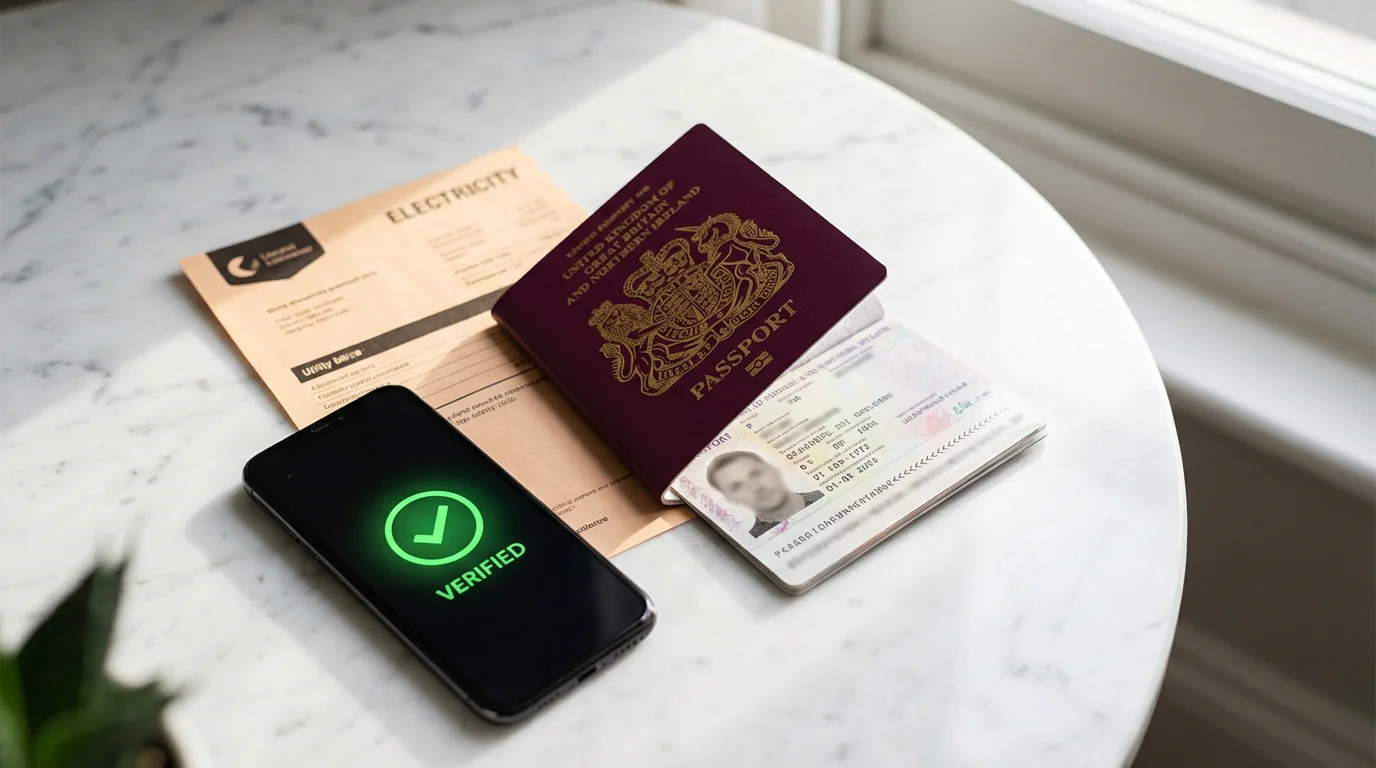
Why KYC Exists at UK Casinos
KYC — Know Your Customer — is the identity verification process that every UKGC-licensed casino must complete before allowing you to play. It’s not optional, it’s not a suggestion, and it’s not something casinos impose to inconvenience you. It’s a legal requirement under the Gambling Commission’s Licence Conditions and Codes of Practice, reinforced by anti-money laundering regulations that apply to every gambling operator in the country.
The purpose of KYC is threefold. First, it confirms that you are who you claim to be — preventing identity fraud and multi-accounting, where a single person creates multiple accounts to exploit promotional offers. Second, it verifies your age. UK gambling law prohibits anyone under 18 from placing bets or playing casino games, and operators face severe penalties — including licence revocation — for allowing underage play. Third, KYC feeds into ongoing anti-money laundering (AML) compliance, ensuring that the funds flowing through casino accounts can be traced to legitimate sources.
For no deposit bonus players, KYC has a specific and immediate relevance: at most UK casinos, you cannot receive or use a no deposit bonus until your identity has been verified. This is a change from the approach some operators used before the UKGC tightened its rules. Previously, casinos could allow play first and verify later — typically at the withdrawal stage. The current framework requires verification before any gambling activity begins, a requirement enforced since May 2019, which means that the free spins or bonus cash you’ve been promised won’t land until the casino has confirmed your identity, age, and address.
This front-loading of verification adds friction to the claiming process, but it also adds protection. Players are verified once, and subsequent deposits, withdrawals, and bonus claims proceed without repeated document requests — unless specific triggers (large deposits, unusual activity patterns) prompt enhanced due diligence checks later.
Documents You Need for Casino Verification
The documentation required for UK casino verification falls into three categories: proof of identity, proof of address, and — in certain circumstances — proof of source of funds. Each serves a distinct compliance function, and having the right documents ready before you register saves time and avoids the frustration of a stalled bonus claim.
Proof of identity requires a government-issued photo ID. The accepted options at virtually all UK casinos are a valid passport, a UK driving licence (photocard), or a national identity card for EEA citizens. The document must be current — expired IDs are universally rejected. When submitting, you’ll need to provide a clear photograph or scan showing all four corners of the document, your full name, date of birth, and photograph. Blurry images, cropped corners, or photos taken in poor lighting are the most common reasons for rejection at this stage.
Proof of address confirms where you live and is typically satisfied by a utility bill (gas, electricity, water, council tax), a bank statement, or an official government letter. The document must be dated within the last three months and must show your full name and residential address. Mobile phone bills are not universally accepted — some casinos do, some don’t. If in doubt, a council tax bill or bank statement is the safest option.
Source of funds checks are not required for every player. They’re triggered at specific thresholds — typically when a player deposits above a certain amount within a set period, or when their cumulative activity crosses a regulatory benchmark. If triggered, you may need to provide payslips, tax returns, bank statements showing salary credits, or documentation of other income sources. For no deposit bonus players who haven’t deposited anything, source of funds checks are unlikely to apply at the initial stage, but they can surface later if you deposit and your activity escalates.
The Verification Process Step by Step
The typical verification flow at a UK casino follows a consistent pattern, though the speed and user experience vary between operators. Here’s what to expect from registration through to a fully verified account.
Registration comes first. You provide your name, date of birth, email, mobile number, and residential address. Most casinos run an automated check against public databases at this point — electoral roll records, credit reference files — to pre-verify your identity electronically. If the automated check succeeds, some operators will grant provisional access immediately while requesting document uploads to complete full verification. Others require documents before any activity is permitted.
Document submission happens through the casino’s verification portal, usually accessible via your account settings or a dedicated upload page. Most modern UK casinos accept photos taken on a smartphone — you don’t need a scanner. The portal will prompt you to upload your ID and proof of address separately. Some operators use live camera verification, where you hold your ID up to your phone camera and the system captures the image in real time, checking for signs of digital manipulation.
Review times range from near-instant to 72 hours depending on the operator. Automated document processing systems can verify a clear passport photo within minutes. Manual review, which kicks in when automated systems flag inconsistencies or image quality issues, takes longer. During peak registration periods — major sporting events, casino launch weeks — review queues extend, and delays of 24 to 48 hours are common.
Once verified, your account is fully active. Any pending no deposit bonus should credit automatically or become available for manual claiming. If the bonus doesn’t appear after verification completes, contact customer support — the issue is usually a timing delay in the system linking your verified status to the promotional trigger, not a terms problem. A quick live chat message typically resolves it within minutes.
Common Verification Problems and How to Fix Them
Verification failures are rarely terminal, but they are frustrating — especially when you’re waiting to claim a no deposit bonus with a ticking expiry clock. The most common issues fall into a few predictable categories, and most have straightforward solutions.
Image quality is the number one reason for document rejection. A photo of your passport taken in dim lighting, at an angle, or with part of the document cut off will fail automated checks and get flagged in manual review. The fix is simple: place the document on a flat, well-lit surface, photograph it from directly above, and ensure all four edges and all text are clearly visible. Avoid using flash, which can create glare on laminated surfaces.
Address mismatches cause the second most common delay. The address you entered during registration must exactly match the address on your proof of address document. If your bank statement says “Flat 2, 14 High Street” and you registered as “14 High Street, Apt 2,” some systems will flag a discrepancy. Consistency in formatting — including flat numbers, abbreviations, and postcodes — prevents this.
Name discrepancies are trickier. If your ID shows a maiden name or a middle name that you didn’t include during registration, the mismatch can stall verification. Casinos typically ask for an additional document to bridge the gap — a marriage certificate, deed poll, or secondary ID showing both names. These situations take longer to resolve because they usually require manual review by the compliance team.
Expired documents are a hard rejection. There’s no workaround — you need a current document. If your passport has expired and your only alternative is a provisional driving licence, most UK casinos will accept it as long as it’s the photocard version and still valid. If your proof of address documents are all older than three months, a fresh bank statement — available instantly as a PDF from most online banking apps — is the fastest path to a valid document.
If verification takes longer than the advertised timeframe and you’re concerned about a no deposit bonus expiring in the meantime, contact support and ask them to note the delay against your account. Some operators will extend the bonus window in cases where verification delays are on their end. Not all will, but it costs nothing to ask — and a documented support interaction gives you a reference point if the issue escalates.