

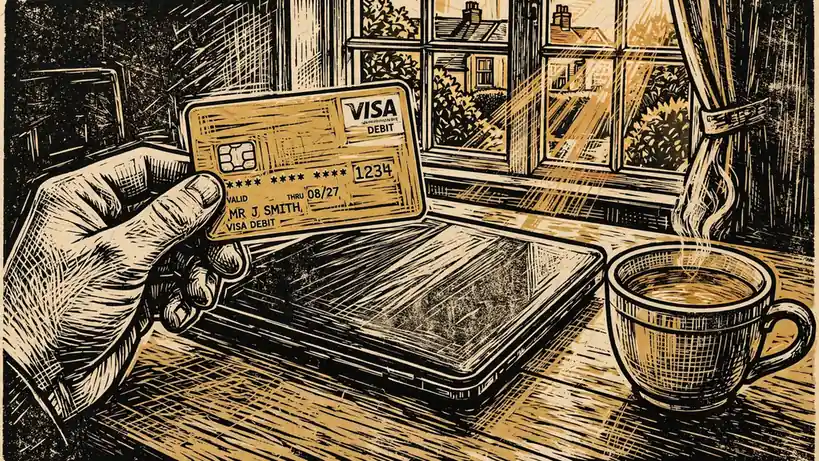
Debit card acceptance depends on eligible card products, casino cashier terms, account limits and the route used for withdrawals.
How Debit Card Acceptance Works at UK Casinos
Debit cards are a familiar way to fund a casino account in the UK. Online casinos that accept debit card deposits commonly list Visa and Mastercard, although the card brand alone does not establish that every card product will work at every casino. Acceptance applies to eligible debit cards, not to credit cards carrying the same logo.
The distinction is how the payment is funded. A debit-card transaction draws on money held in the linked bank account, subject to the bank’s own checks and available balance. A credit-card transaction uses borrowing from the card issuer. For gambling payments at UK-licensed casinos, that difference is decisive: credit-card payments are prohibited, while debit-card payments remain a commonly accepted route.
The prohibition took effect on 14 April 2020 and has not been relaxed. It applies to credit-card payments for gambling, including where credit-card funds are routed through a money service business. A payment does not become permissible merely because an intermediary sits between the card issuer and the casino. Remote gambling licensees cannot accept credit-card funds for gambling, and they cannot accept wallet payments where the wallet allows credit-card funds to be used for gambling.
Casinos That Accept USDC in the UK: What to Check
This means “card accepted” is not a complete description of the permitted transaction. The relevant category is debit, rather than credit. A credit card should not be treated as an alternative if a debit-card transaction is unavailable or declined. Nor does adding a digital wallet necessarily change the underlying funding source: the restriction still applies when credit-card funds are being used for gambling.
For UK players, a legal online casino must hold a current operating licence from the Gambling Commission. That regulatory framework is separate from the payment brand. Visa and Mastercard are payment networks; they are not casino licences and do not, by themselves, establish that a gambling site is authorised to serve customers in Great Britain. Likewise, a site’s use of familiar card branding is not evidence that a particular transaction will be accepted.
The phrase “debit card casinos” therefore describes a payment option, not a special type of casino. It does not imply that every licensed casino accepts every debit card, or that a card accepted for one account will necessarily be accepted for another. The basic market position is narrower: UK casinos commonly accept debit cards, including Visa and Mastercard, while credit-card payments for gambling are barred at UK-licensed sites.
Casinos That Accept Diners Club in the UK
The distinction matters even before an account is funded. A card may be labelled Visa or Mastercard while being issued as debit, credit or another product. The logo identifies the network, not the source of funds. For the transaction to fall within the permitted debit-card route, it must be a debit payment rather than a credit payment. If the product type or funding source is unclear, the label on the front of the card is not a reliable substitute for checking its classification.
“Best” or “top” debit-card casinos is not a meaningful conclusion based on card acceptance alone. The fact that a casino accepts debit cards says nothing by itself about its wider terms, other payment routes, withdrawal arrangements or promotional conditions. Those are separate questions. For this section, the useful comparison is simply between a permitted debit-card payment and a prohibited credit-card payment for gambling.
This boundary also rules out a common misunderstanding: the restriction is not a temporary cashier setting that can be bypassed by selecting another payment route. A casino operating under a UK licence cannot accept credit-card payments for gambling, including credit-card funding passed through a money service business. A wallet is not a workaround if it permits credit-card funds to be used for gambling. The source of funds remains material.
In practical terms, a debit card is a way to transfer funds from a bank account into a casino account where the operator accepts that card. The payment is not a loan from the card issuer. Credit-card borrowing, by contrast, cannot be used to place gambling funds with a UK-licensed casino. That difference defines what “casinos that accept debit card” means in the UK: ordinary debit-card access is common, but card acceptance does not extend to credit-funded gambling.
The rule is specific to gambling payments and has remained in force since the regulator introduced the ban on 14 April 2020. The resulting payment boundary is straightforward: eligible debit cards may be used where accepted; credit cards may not be used for gambling at UK-licensed casinos. The card network name does not remove that distinction.
Credit Card Prohibition
UK-licensed casinos are prohibited from accepting credit-card payments for gambling. This restriction includes funds routed through money service businesses or digital wallets that allow credit-card use.
Payment Methods and Cashier Compatibility
An online casino may show a payment brand on an information page without offering it to every customer or for every transaction. The cashier is the practical check: it shows which routes are enabled for the account and whether each one is available for a deposit, a withdrawal, or both. A method should not be treated as a complete payment route merely because it appears beside the deposit button.
Visa and Mastercard are named in specialist casino reviews as card options, but that does not establish that every UK customer can use every card product at every site. Current availability needs to be confirmed in the casino cashier. The same check applies to an online casino with debit card payments: the relevant question is not only whether card deposits are described, but whether the card route is offered for the intended transaction.
A cashier can present separate lists for adding funds and requesting a payout. Those lists need to be read independently. A payment method shown for deposits does not, by that fact alone, support withdrawals. Conversely, a withdrawal route may appear only after an eligible deposit or after account checks have been completed. The displayed options, rather than a generic payment-method page, are the operative information for that account.
This distinction matters when choosing an online casino debit card deposit. A card may be accepted to fund play while the casino’s withdrawal process follows a different route. Where the cashier offers card payouts, the card can be considered for both directions; where it does not, the payment arrangement is not a two-way card route. The distinction is about availability, not an estimate of processing speed or a promise about when funds will arrive.
Bank transfer and open banking are other routes that may appear in a cashier. A specialist review reports that these methods can support instant deposits and fast withdrawals at many sites. That description should be treated as a report about availability, not as a guarantee applying to a particular casino. The live cashier still needs to show the method for the relevant transaction before it can be relied on.
Casino Payments in the UK: Methods and Deposits
Some UKGC-licensed casinos also offer Apple Pay for deposits. That fact establishes a deposit option, not withdrawal support. If Apple Pay is displayed only when adding funds, it should be treated as a deposit route rather than assumed to be a way to receive a payout. A casino’s own payment information can clarify the arrangement, but the cashier determines what is currently enabled.
When comparing online slots with debit card access, game availability is separate from payment compatibility. A casino can offer games while a particular payment method is absent from the account cashier, or can offer a card for deposits without offering it for withdrawals. The payment route therefore needs its own check; the presence of a game catalogue does not answer it.
A useful comparison records each method in two columns: deposit and withdrawal. Mark the route as available only where the cashier or the casino’s current payment terms confirm that direction. If a method appears in one column alone, it is a one-way option for the account as presented. This avoids treating a list of brands as if it were a list of interchangeable, two-way services.
DO
- Confirm the payment method in the live cashier.
- Distinguish between deposit and withdrawal availability.
- Verify that the card is a debit product.
DON’T
- Assume a deposit method works for withdrawals.
- Rely on general payment pages instead of the cashier.
- Treat a card brand as proof of fund source.
For a debit card casino online UK, the same discipline applies across card brands and other routes. A payment page may describe several methods collectively, while the account cashier displays a narrower selection. Availability can depend on the site’s current setup and the payment product being used. A method listed in a general description is therefore a starting point for checking, not sufficient confirmation that it is active for a specific customer.
The choice is clearer once each route has been classified by function: card, bank-based service, digital wallet, or deposit-only option. The classification does not itself establish availability. It simply prevents a deposit method from being mistaken for a payout method and keeps comparisons tied to what the casino actually offers. For an online casino that accepts debit card payments, the cashier should show the card option for the transaction in question; other methods should be assessed in the same way.
Casinos That Accept Wirecard in the UK: Payment Checks
The practical standard is modest but exact: confirm the method in the relevant cashier section, distinguish deposits from withdrawals, and do not infer support in one direction from support in the other. Availability is a property of the specific account and transaction, not a permanent feature of a payment brand.
Checking a Casino’s Debit Card Terms
A casino’s general payment page is a starting point, not confirmation that a particular debit card can be used for a particular account. The practical check is narrower: whether the cashier currently offers the relevant card option for a UK account, whether the card product is eligible, and what currency the account will use. Those details determine whether a deposit can proceed on the expected terms.
Specialist casino reviews may list Visa and Mastercard as accepted methods, but that does not establish current UK availability for every operator or every card product. The cashier is the more relevant check before a transaction. It shows which options the operator makes available to that account at that time. If the card brand appears in a review but not in the cashier, the review does not make it usable.
Card brand alone is not a complete eligibility test. A Visa or Mastercard debit card may still be treated differently according to its product or the operator’s current payment settings. The useful distinction is between a method named in general information and a method actually offered for the intended deposit. Terms should be read alongside the cashier rather than treated as substitutes for it.
Deposit Verification
- Confirm the cashier offers the card method for your account.
- Check that the card product is an eligible debit card.
- Verify the casino account is denominated in GBP.
- Review any currency-conversion information before authorising.
The same distinction applies to account currency. Specialist review pages may state that GBP is supported, but the account’s selected currency should be confirmed before the first transaction. A UK location does not, by itself, establish the currency in which an account is denominated. If the account is set to another currency, a card deposit may involve conversion, changing the amount charged relative to the amount displayed in the casino account.
The currency check belongs before funding, not after a transaction appears on a statement. The account profile or cashier should identify the currency used for balances and transactions. Where the stated account currency and the card’s billing currency differ, the conversion terms become part of the cost. The displayed deposit value alone is not necessarily the final amount taken from the card account.
A useful pre-deposit check can therefore be kept short:
- Confirm that the cashier offers the card method for the account.
- Check that the card product is eligible, rather than relying on the brand name alone.
- Confirm that the casino account is denominated in GBP if GBP is expected.
- Review any currency-conversion information shown before authorising the payment.
These checks address separate points. Method availability answers whether the casino is presenting a card route. Product eligibility answers whether that particular card can use it. Currency answers how the amount will be recorded and whether conversion may intervene. A positive answer to one does not settle the others.
Terms can also differ between the public payment information and the live cashier. Payment options may be adjusted, and a page that describes a method in general terms cannot confirm that it remains enabled for every account. For that reason, the cashier should be checked close to the time of deposit. If it does not display the expected card option, the published description is not enough to treat the transaction as available.
The phrase “best debit card casino” can obscure these conditions. A ranking cannot establish that a specific card product is eligible today, or that the account is set to GBP. Those are transaction-level checks, not qualities that can be inferred from a list of casino names. A useful comparison is based on the terms visible for the account: the available card route, the eligible product and the account currency.
Before confirming a deposit, the payment screen should match the intended method and currency. If either differs, the expected transaction has not been established. A pause at that point costs nothing; proceeding without checking can turn a straightforward card payment into a conversion or eligibility issue.
Casinos that accept Upaycard in the UK: how to check
Deposit Amounts and Account Limits
A debit card casino deposit is governed by two separate figures: the minimum accepted for a transaction and the limits that cap deposits over a transaction, a day or a month. The first determines whether a deposit can be submitted; the second controls how much can be added within a stated period. Neither figure should be assumed to apply across every payment route or account.
Specialist casino reviews describe minimum deposits in the £10–£20 range, with the amount dependent on the payment method selected. That range is a guide to what may be offered, not a fixed UK-wide tariff. The cashier’s stated minimum is the operative figure for a particular casino and route. A card deposit below that amount may be declined even if the card itself is accepted.
The maximum can be less straightforward. A casino may set one ceiling for an individual deposit and separate cumulative limits for daily or monthly activity. The applicable caps can differ by payment method and account status, so a figure displayed for one route does not establish the allowance for another. Account-level controls can also reduce the amount that may be deposited. The practical amount available is therefore the lowest cap that applies to the chosen route and account, rather than the largest figure shown in a general payment description.
In Great Britain, remote gambling operators must ask new customers to set a financial limit before the first deposit. Account controls must also make limit-setting accessible after registration. These controls are distinct from a payment provider’s own transaction ceiling: one concerns the account’s gambling deposits, while the other may restrict what the payment route can process. A declined transaction can therefore reflect either layer.
Deposit Limits
A deposit is governed by both the minimum amount required for a transaction and the specific caps set for daily or monthly activity. These limits may differ between payment routes and account types.
For someone comparing debit card casino sites in the UK, the useful comparison is not a headline maximum in isolation. The relevant details are the minimum for the selected route, the per-transaction cap, any daily or monthly cap, and the account limit already in force. A cashier may show some figures only after login or route selection, so the amount should be checked at the point where the deposit is configured.
There is no benefit in treating the highest permitted deposit as a spending target. A deposit limit is a boundary, not a recommendation, and the account’s chosen financial limit may be lower than the casino’s payment ceiling. Where those controls differ, the lower active amount determines what can be deposited.
A clean calculation starts with the amount intended for the account, then checks that it meets the route’s minimum and remains within each relevant cap. This avoids confusing a successful card authorisation with permission to exceed the account’s own limit. For debit card slots in the UK, the deposit amount remains an account transaction; it does not change the separate controls attached to play or the operator’s duty to provide limit tools.
Debit Card Withdrawals: Route and Timing
A debit card deposit and a debit card payout are separate stages, with different processing behind them. A card payment may reach a casino account instantly, while a withdrawal can take several business days, according to a specialist review. The speed of the deposit therefore says little about when withdrawn funds will arrive.
The first step is the casino’s own approval. A withdrawal request is not the same as a completed payment: the operator must process it before funds are sent out. The time taken depends on that internal process and whether the account has been fully verified. A pending status can therefore reflect work still taking place at the casino rather than a delay within the card network.
Casinos that accept iDEAL in the UK: payment checks
First withdrawals may take longer while KYC checks are completed, according to specialist reviews. If verification is still outstanding, the casino may need to confirm account details before approving the payment. Once that review is complete, the withdrawal still has to move through the payment route. These stages should be distinguished when estimating timing: approval and delivery are not one event.
The return route is also shaped by anti-money-laundering controls. UK rules generally require a payout to go back to the original payment source. Where a debit card funded the account, that can mean the casino routes the withdrawal back to that card, rather than treating the payout as an unrelated transfer. The requirement is a control on the movement of funds, not a promise that every card withdrawal will be processed at the same speed.
A casino withdrawal to a debit card can involve the operator’s approval, any outstanding verification, and the subsequent payment processing. Those steps explain why an instant deposit does not establish an instant payout. The final arrival time depends on the casino’s handling and the player’s verification status; a general claim that a debit card is a fast-withdrawal method would leave out the main variables.
The cashier and withdrawal terms should make clear how a card payout is handled, including whether the casino returns funds to the card used for depositing or applies another process. The available route can depend on the payment arrangement and account circumstances. If the casino requests additional checks or cannot send the full payout to the original source, it may require further verification before confirming an alternative route. That can add processing time; it does not make an alternative route automatically available.
Timing Realities
An instant deposit does not guarantee an instant payout, as withdrawals must go through internal approval and verification processes.
For a realistic timing assessment, separate the casino’s approval period from the payment’s delivery period, and account for verification before submitting a request. A displayed processing estimate may describe only one part of that chain. Where terms are unclear, the operator’s stated withdrawal procedure is more useful than assuming that a card deposit and a card withdrawal move at equal speed.
When Another Payment Route May Be More Practical
A debit card is a direct way to fund a casino account, but it is not the only route. The practical difference is whether a payment method suits deposits, withdrawals or both. A method shown in the cashier for adding funds should not be assumed to work in reverse.
Bank transfers can suit players who prefer to move funds through a bank account rather than enter card details. Their delivery time is not fixed: cut-off times, weekends and currency conversion can affect when a transfer arrives. A specialist review describes bank transfers and open banking as capable of supporting instant deposits and fast withdrawals at many sites. That is a possibility, not a service standard; availability and timing depend on the casino and the payment route offered.
Open banking can provide another bank-linked route. Where a casino offers it, the payment is authorised through a banking service rather than processed as a card transaction. The same specialist-review qualification applies to claims about speed: an instant deposit or fast withdrawal may be available at some sites, but the wording does not establish that every casino supports both directions. The cashier’s deposit and withdrawal options are the relevant terms.
Casinos That Accept Tether in the UK: Payment Checks
Paysafecard serves a narrower purpose. It is a prepaid voucher for deposits only, so it should not be treated as a route for receiving casino winnings. Its role is therefore different from a bank transfer or an eligible card route: it can fund play, but another supported method would be needed for a payout.
For a casino deposit with a debit card, the comparison is less about which method sounds fastest and more about the actual route available at the account. A card may be the straightforward choice where it is accepted, while a bank-linked option may be more practical if its deposit and withdrawal functions suit the account. A voucher fits only where a deposit-only method is acceptable.
The useful comparison is the cashier’s stated function for each method, not a generic claim that one payment type is best. Deposit access does not establish withdrawal access, and a reported fast service does not guarantee the same timing across operators. A debit card casino site may offer alternatives, but only the methods actually shown for each transaction can be treated as available.
Keeping Deposits and Payouts on a Clear Payment Trail
A casino that accepts debit card deposits UK players can use still needs to establish who owns the gambling account and the payment method. The names and account details should therefore match. When a deposit comes from an account belonging to someone else, basic ownership checks become harder to resolve and the transaction may face avoidable friction.
Ownership Mismatch
Attention Always ensure the casino account and the payment method belong to the same person to avoid ownership checks and transaction friction.
A clear payment trail links the customer’s casino account to a payment source in that same customer’s name. The simplest arrangement is often one named account used consistently for deposits and payouts, where the cashier permits that route in both directions. This is not a promise of immediate processing; it is a way to keep the ownership record coherent.
Returning funds to the original payment source is a common anti-fraud and anti-money-laundering control. It helps connect the payout to the money previously deposited, rather than creating an unexplained transfer to a different account. If the original route cannot be used and an alternative is requested, the casino may need additional verification before processing it.
For an online casino that accepts debit card deposits UK customers should pay attention to the account holder details as well as the card logo. A card bearing a familiar network mark does not establish that the card is eligible for a particular account, nor does it resolve a mismatch between the cardholder and the casino customer. Ownership is the relevant link.
Using several routes without a clear reason can make that link less straightforward. A change of payment source is not automatically improper, but it can prompt questions about who supplied the funds and where a payout should go. Keeping records of the named source and using it consistently reduces the scope for routine discrepancies to become a separate verification issue.
The practical test is simple: the casino account, the payment account and the person requesting any return of funds should point to the same customer. A best casino that accepts debit card payments cannot be identified from the payment trail alone; the useful distinction is whether the cashier’s rules support a traceable route and whether the account details match. A clean record is not decoration. It is evidence that the funds have a recognisable owner.
Casinos That Accept Instadebit in the UK: What to Check
Debit Card Deposits and Casino Bonus Eligibility
A debit card can be accepted for deposits without making every promotion available. Payment acceptance and bonus eligibility are separate decisions: the cashier determines whether a transaction can be made, while the promotion’s conditions determine whether that payment method qualifies. A card deposit therefore does not, by itself, establish entitlement to a welcome offer or another casino bonus.
The distinction matters when comparing the headline value of an offer. Its advertised amount says little about whether a particular deposit qualifies. Eligibility may depend on the method selected, so the payment option and the promotion need to be considered together. A debit-card player should treat the offer as unavailable until the casino’s current terms confirm otherwise; a prominent banner is not a substitute for that condition.
Other payment methods illustrate why this check cannot be generalised across a cashier. A specialist review reports that PayPal can be excluded from bonus eligibility, while Skrill and Neteller are described as being excluded from promotions at some sites. These are method-specific observations, not a rule for every casino or a guarantee about current terms. Availability and promotional treatment can differ between operators.
The reverse assumption is equally unreliable. A casino accepting Visa or Mastercard does not necessarily mean that every card deposit qualifies for every promotion. Nor does a promotion’s availability prove that it applies to all payment methods. The relevant question is whether the terms attach eligibility to the selected method, not whether the method appears in the cashier.
Bonus Eligibility
Payment acceptance is separate from promotion eligibility; a casino may accept a debit card for deposits while excluding it from specific bonus offers.
A useful comparison separates three figures or conditions: the advertised bonus value, the payment method required or permitted, and the offer’s remaining conditions. The first is the packaging; the second determines whether the deposit can enter the promotion at all. If the selected card is excluded, the headline value is not part of the transaction’s return.
This also applies to searches for a debit-card welcome bonus or casino games funded by card. The card funds the account; it does not define which games, promotions or promotional terms apply. For casinos serving Great Britain, only operators holding the relevant UK Gambling Commission licence may legally offer remote gambling to local customers. “Non-GamStop” is not a payment category and should not be treated as evidence that a site or offer is suitable.
Deposit Bonuses: Check the Payment Conditions First
A debit card deposit does not, by itself, qualify an account for a promotion. The casino’s terms decide whether the offer is available, which payment methods count and what action is required. A card payment may be accepted for gambling while remaining outside the conditions of a particular bonus.
Debit Card Casino Sites in the UK: Payment Terms
For a deposit bonus, the relevant detail is whether the promotion accepts deposits made by debit card. The payment method named in the cashier and the payment methods permitted by the offer are separate checks. A successful deposit confirms only that funds reached the account; it does not establish that a bonus has been added or that the deposit meets the offer’s terms.
Payment exclusions can apply to other methods too. A specialist review reports that PayPal may be excluded from bonus eligibility. Specialist reviews also report that Skrill and Neteller are often excluded from promotions. These are not fixed rules for every casino or offer: the current promotion terms govern.
A no-deposit bonus is different in structure because it is not triggered by making a deposit. The presence of a debit card in the cashier therefore says nothing about whether such an offer is available. Eligibility and any conditions attached to it still depend on the specific promotion.
Bitcoin Casinos in the UK: What to Check
Before counting a bonus as part of a deposit’s value, check the offer’s payment-method wording and confirm that the promotion is available to the account. If the terms exclude the chosen route, the deposit amount remains a deposit; it does not become bonus-eligible by being accepted. The distinction is financial, not cosmetic: only an offer whose conditions are met belongs in the calculation.
Visa Debit Cards and Payment Safety
A Visa debit card can be a payment option at a UK casino, but a general payment-method listing does not confirm that every Visa product will work. A specialist review lists Visa and Mastercard among the methods discussed; current UK availability and eligibility for a particular card still need to be confirmed in the casino cashier.
The distinction matters because acceptance can depend on the card product and the operator’s current payment setup. The cashier is the practical check before a deposit: confirm that Visa is displayed for the account and that the card type is accepted. A logo elsewhere on the site is not a transaction approval.
Safety also depends on matching the payment details to the gambling account. When the casino account and Visa card belong to the same customer, basic ownership checks are less likely to create avoidable friction. Using another person’s card introduces an ownership mismatch that may delay or prevent a transaction.
Before entering payment details, the UKGC public register can be used to confirm that the casino holds a current operating licence. A UK-licensed casino cannot accept credit-card payments for gambling, including credit-card funding routed through a money service business. A debit card should therefore be identified correctly; the Visa brand alone does not establish whether a particular card is a debit product or whether the cashier will accept it.
The useful check is specific: confirm the operator’s licence, select Visa in the cashier, and ensure the card is the account holder’s own eligible debit card. Acceptance at one casino does not establish acceptance at another, and a listed payment method is not a guarantee that a particular card transaction will be approved.
What is the fastest withdrawal method for UK casinos?
PayPal, open banking services and debit cards linked to fast payout systems are generally among the quickest options. The casino’s approval process and your verification status also affect how soon funds arrive.
Are Visa and Mastercard deposits definitely debit cards?
No. Visa and Mastercard are payment networks, and their cards can be debit or credit; check the card type and the casino cashier. UK-licensed casinos cannot accept credit-card payments for gambling.
Why must withdrawals return to the deposit method?
Returning funds to the original payment source is a common anti-fraud and anti-money-laundering control. Using a different route may require additional verification.
Do UK casino withdrawals require verification?
Verification may be needed, and first withdrawals can take longer while it is completed. A fully verified account can help avoid delays.
Why can a fast payout casino still delay my withdrawal?
A casino’s internal approval process can add time, and verification may take longer on a first withdrawal. The payment provider’s processing can also affect delivery.
Are fast casino withdrawals guaranteed?
No. Withdrawal speed depends on the casino’s approval process, whether your account is verified and the payment route’s processing time.